Panier
Il n'y a plus d'articles dans votre panier
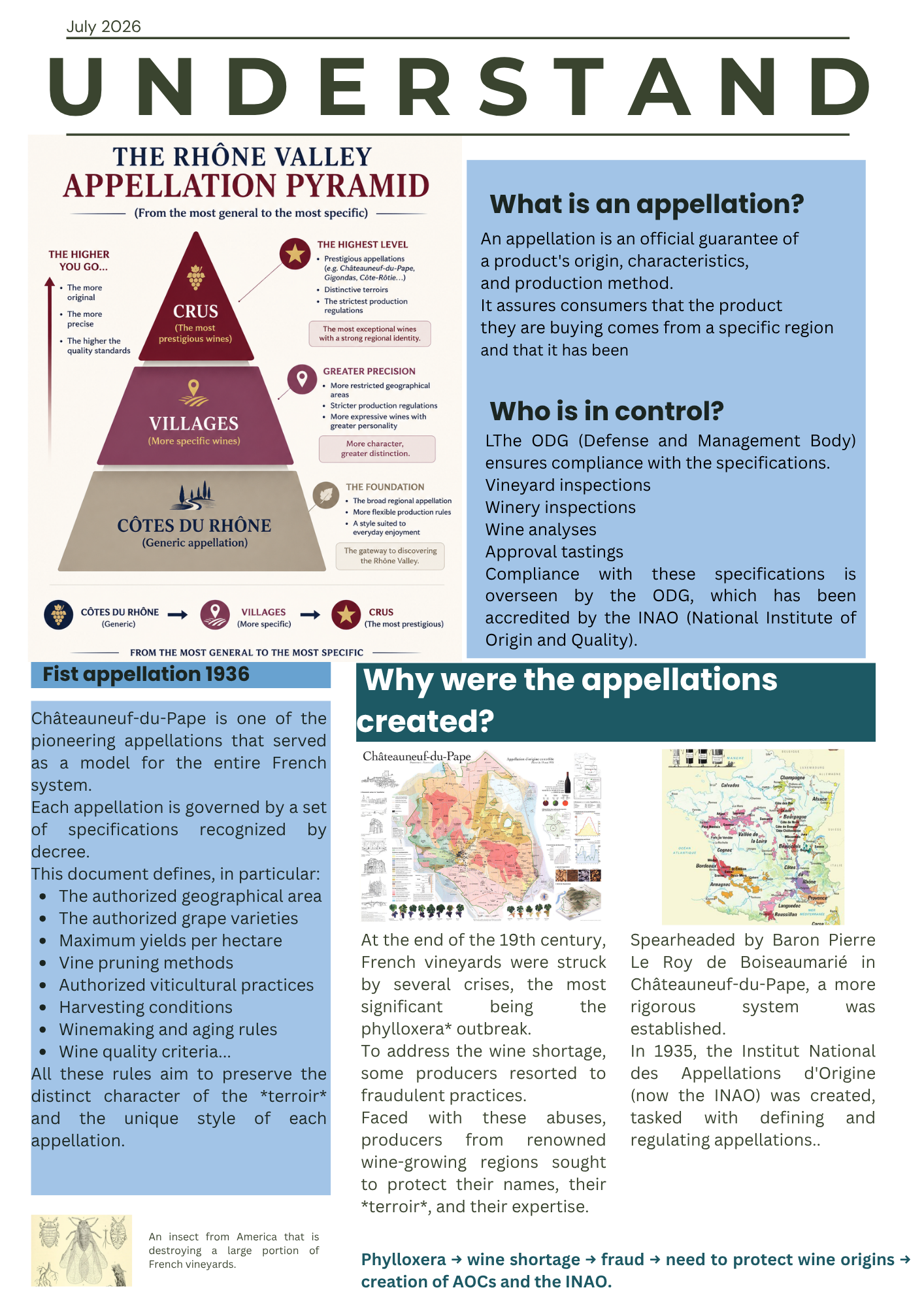
Why Were Appellations Created?
At the end of the 19th century, the French vineyard was struck by several major crises, the most significant being the phylloxera epidemic. This tiny insect, introduced from North America, devastated a large proportion of France's vineyards.
As wine production declined dramatically, fraudulent practices became increasingly common to meet market demand. Some producers falsely used the names of prestigious wine regions, blended wines from different origins, or artificially increased production volumes.
In response, winegrowers sought to protect the origin of their wines, their terroirs and their traditional know-how.
Under the leadership of Baron Pierre Le Roy de Boiseaumarié in Châteauneuf-du-Pape, a stricter system of geographical protection was gradually established. In 1935, the INAO (French National Institute of Origin and Quality) was created to define, protect and monitor appellations.
Each appellation is based on three fundamental principles:
- A clearly defined geographical area;
- A detailed set of production specifications (cahier des charges);
- Regular inspections to ensure compliance with production rules.
The objective is to guarantee product authenticity, prevent fraud and provide consumers with wines of recognised origin and quality.
Phylloxera → Wine shortage → Fraud → Protection of origin → Creation of the AOC system and the INAO
Who Oversees the Appellation System?
Each appellation is managed by an ODG (Defence and Management Organisation), which represents the producers and ensures that the production specifications are respected.
Inspections are carried out by an independent certification body approved by the INAO and include:
- Vineyard inspections;
- Winery inspections;
- Wine analyses;
- Official tasting panels.
The INAO oversees the entire system to ensure that every appellation complies with its regulations.
How Does an Appellation Influence the Wine?
An appellation does not guarantee that one wine is "better" than another.
Instead, it guarantees that the wine complies with a strict set of rules linked to its geographical origin.
These rules define, among other things:
- The geographical production area;
- The authorised grape varieties;
- Maximum vineyard yields;
- Vineyard management practices;
- Harvest conditions;
- Winemaking and ageing methods.
The aim is to preserve the identity of each terroir and the distinctive style of every appellation.
Example: Côtes du Rhône AOC
To produce a wine under the Côtes du Rhône AOC, a winemaker must:
- Grow the vines within the official appellation boundaries;
- Respect the authorised maximum yields;
- Use only the grape varieties permitted by the production specifications;
- Comply with the vineyard management and winemaking regulations.
Why Is One Bottle More Expensive Than Another?
The appellation alone does not determine a wine's price.
However, the stricter the regulations and the smaller the production area, the stronger the wine's identity generally becomes.
For example:
Côtes du Rhône
- Large production area
- Relatively flexible production rules
Côtes du Rhône Villages
- Smaller geographical area
- More demanding production requirements
Cru (Châteauneuf-du-Pape, Gigondas, Vacqueyras...)
- Recognised terroir
- Specific production regulations
- Strong regional identity
The Three Levels of Rhône Valley Appellations
Côtes du Rhône
This is the regional appellation and the first level of the Rhône Valley hierarchy.
- The largest production area in the Rhône Valley;
- A common set of production rules throughout the appellation;
- A wide diversity of terroirs and wine styles;
- Represents the majority of Rhône Valley wine production.
Objective: to guarantee the Rhône origin of the wine while offering excellent accessibility.
Côtes du Rhône Villages
This is the intermediate level between Côtes du Rhône and the Crus.
- More limited geographical area;
- Stricter production requirements;
- Lower permitted yields;
- Wines with greater character and identity.
Some recognised villages may even add their village name to the appellation, including:
- Plan de Dieu
- Séguret
- Visan
- Gadagne
- Saint-Gervais
Objective: to highlight particularly distinctive terroirs.
Rhône Valley Crus
The Crus represent the highest level of the Rhône Valley appellation hierarchy.
- Individual appellations based on recognised terroirs;
- Production rules specific to each Cru;
- Strong geological, climatic and historical identity;
- National and international reputation.
Examples include:
- Châteauneuf-du-Pape
- Gigondas
- Vacqueyras
- Rasteau
- Cairanne
- Lirac
- Tavel
Objective: to express the unique character of an exceptional terroir.
Key Takeaways
📍 The higher you move up the appellation pyramid:
- the smaller the geographical area;
- the stricter the production regulations;
- the stronger the expression of the terroir.
Côtes du Rhône → Côtes du Rhône Villages → Cru
From the most general to the most specific.
An appellation is not a quality ranking, but a guarantee of origin, traceability, and faithful expression of a specific terroir.