Châteauneuf-du-Pape, an exceptional appellation in the heart of the Rhône Valley
“May this commitment to quality never be abandoned. We are not made for standardised production. No! We are unbeatable when it comes to the qualities for which a craftsman becomes an artist. Quality is the hallmark of French genius.”
— In praise of the Châteauneuf-du-Pape appellation by Baron Pierre Le Roy
Located in the heart of the southern Rhône Valley, the Châteauneuf-du-Pape appellation has embodied French winemaking excellence for centuries. This legendary wine region, whose reputation extends far beyond France’s borders, is the result of a unique terroir, a remarkable history and one of the most demanding regulatory frameworks in the world of wine.
A terroir shaped by history
The village of Châteauneuf-du-Pape owes much of its identity to the presence of the popes in Avignon from the 14th century onwards. As discerning lovers of the region’s wines, they encouraged the planting of vines around their summer residence. Under the impetus of Pope John XXII, a castle was built on the heights of the village, overlooking a rapidly expanding vineyard. The wines soon acquired the prestigious nickname “Pope’s Wine” and found their way onto the tables of Europe’s most influential figures.
After a period of prosperity, the vineyard was severely affected by the phylloxera crisis at the end of the 19th century. The reconstruction of the vineyards, made possible by grafting onto resistant rootstocks, marked a decisive turning point. It paved the way for collective efforts to protect the origin and quality of the wines.
The birth of a pioneering appellation
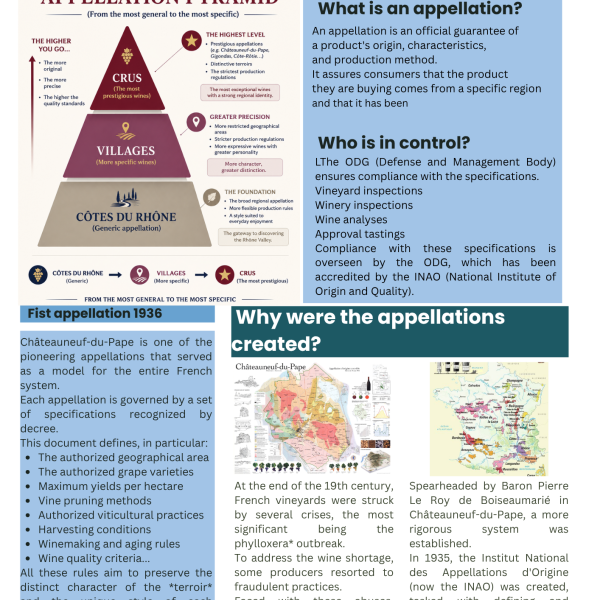
It was at the beginning of the 20th century that Châteauneuf-du-Pape made history as a model of wine regulation. Faced with fraud and the misuse of the appellation’s name, local winegrowers organised themselves under the leadership of Baron Pierre Le Roy de Boiseaumarié. A visionary lawyer and winegrower, he played a decisive role in securing legal recognition for the appellation.
In 1936, Châteauneuf-du-Pape officially became the first Appellation d’Origine Contrôlée (AOC) in France. This founding decree precisely defined the geographical area, authorised grape varieties, cultivation practices and winemaking regulations. It laid the foundations for a system that would go on to inspire all French appellations, now regulated by the INAO.
Grape varieties: 13 or 18, a unique wealth
One of the pillars of the identity of the Châteauneuf-du-Pape appellation lies in its exceptional range of grape varieties. Historically, 13 grape varieties are authorised. However, when colour variations (white, grey and black) are taken into account, as many as 18 grape varieties may be used in the production of the wines.
Grenache dominates the blends, accounting for approximately two-thirds of the plantings. It is complemented by Syrah and Mourvèdre, which contribute structure, freshness and complexity. Other grape varieties, sometimes used in very small proportions, play a role in adding balance and nuance. This diversity is expressed through the traditional practice of co-planting and blending, a historic signature of the appellation.
All of these grape varieties can be used in the production of both red wines and white wines, although the styles and proportions vary.
Powerful red wines and confidential white wines
Châteauneuf-du-Pape wines are exclusively still, dry wines. Red wines, which account for approximately 93% of production, are renowned for their power, aromatic richness and remarkable ageing potential. Over time, they develop complex notes of ripe fruit, spices, garrigue and undergrowth.
White wines, which are rarer (around 7% of production), stand out for their balance, roundness and aromatic freshness. Made from grape varieties such as Clairette, Roussanne and Bourboulenc, they offer remarkable complexity and often-underestimated ageing potential.
One of the strictest sets of production regulations
The reputation of the appellation is built on demanding production regulations. Yields are deliberately limited to 35 hectolitres per hectare, encouraging concentration and quality in the grapes. Vine pruning is strictly regulated, as are cultivation methods.
Harvesting must be carried out entirely by hand, qualitative sorting is mandatory, enrichment is prohibited for red wines, as is the use of oak chips. Malolactic fermentation is mandatory, and the minimum alcohol level is set at 12.5% ABV, one of the highest among French AOCs.
An extraordinary natural terroir
The Châteauneuf-du-Pape vineyard covers approximately 3,200 hectares spread across five municipalities. It is based on a mosaic of soils, including the famous galets roulés, large rounded stones capable of storing heat during the day and releasing it at night, thereby promoting optimal grape ripening.
The hot, dry Mediterranean climate, combined with the influence of the Mistral, creates ideal conditions for vineyard health. This combination of soils, climate and winemaking expertise enables the production of powerful, complex wines that are deeply marked by their terroir.
The bottle, a symbol of identity
Beyond the wine itself, the identity of Châteauneuf-du-Pape is also expressed through its iconic bottles. The armorial bottle, introduced in 1937, features embossed symbols of the papacy. It guarantees the origin of the wine and compliance with the appellation’s production regulations.
In 2003, a contemporary bottle was introduced: the Mitrale. Designed to address the challenges of modernity, traceability and export, it combines distinctive design with high quality standards. These two bottles embody the same ambition: to showcase the authenticity and excellence of Châteauneuf-du-Pape wines.
Between centuries-old tradition and carefully managed innovation, the Châteauneuf-du-Pape appellation stands as an absolute benchmark in the world of wine. Its red wines and white wines, produced from a unique terroir and 13 or 18 grape varieties, reflect a constant pursuit of quality. Today, Châteauneuf-du-Pape continues to shine on the international stage, remaining true to the visionary spirit of its founders and the high standards upheld by its winegrowers.