Shopping Cart
There are no more items in your cart
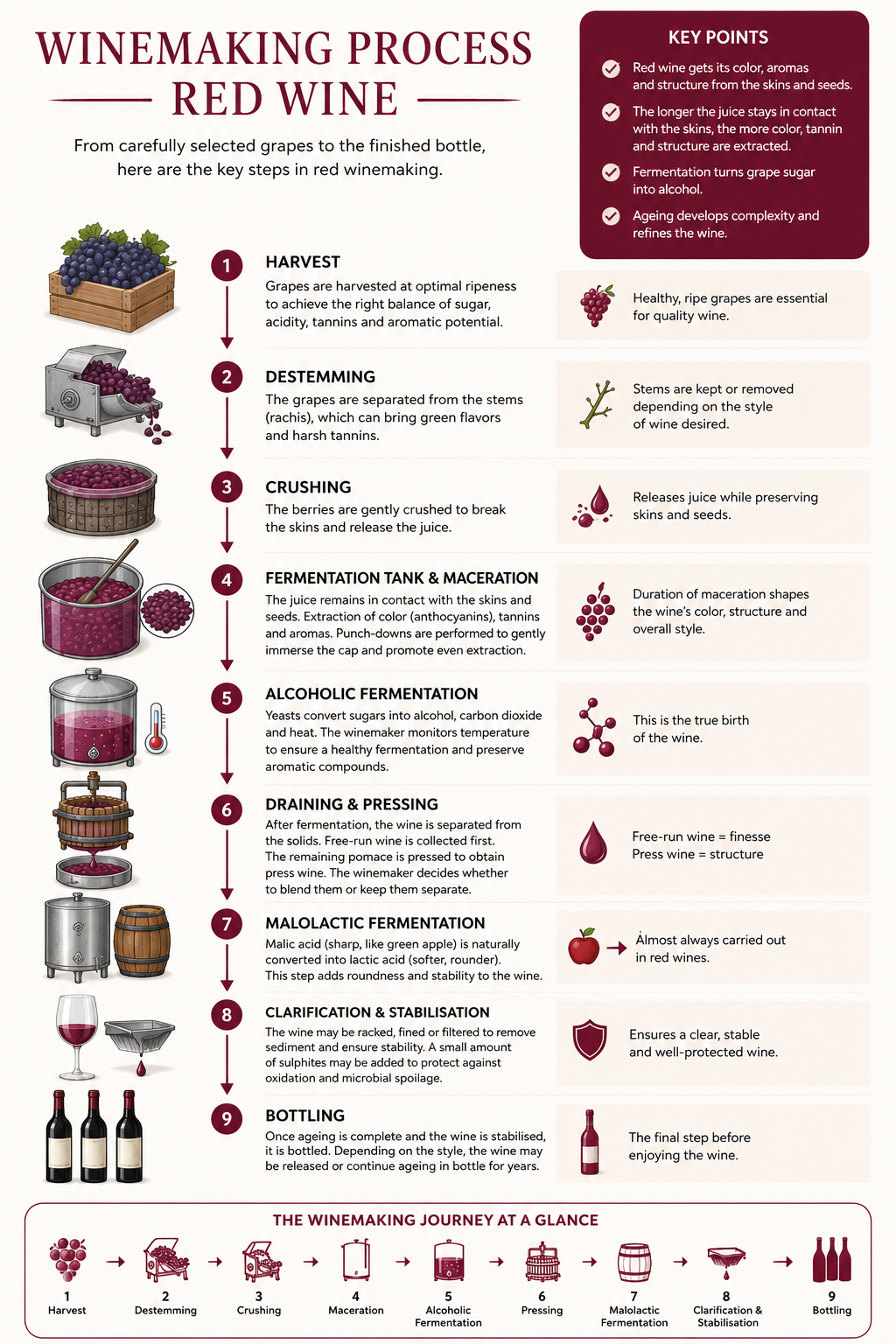
Understanding Red Wine Winemaking
Summary
Red wine is made by fermenting grape juice in contact with the skins and seeds. This process extracts the wine's colour, tannins and aromatic compounds before ageing and bottling.
Winemaking is the process of transforming grapes into wine. In red winemaking, the key characteristic is that the wine's colour, part of its aromatic profile, and its structure come from the grape skins and seeds.
Contrary to popular belief, the pulp of black grapes is generally clear and colourless. The red colour of wine is therefore not naturally present in the juice. It is obtained through maceration, the prolonged contact between the juice and the solid parts of the grapes.
1. Harvest
Everything begins with harvesting the grapes at optimum ripeness. The winemaker looks for the ideal balance between sugar, acidity, tannin ripeness and aromatic potential.
Once harvested, the grapes are quickly transported to the winery to preserve their quality.
2. Destemming and Crushing
Upon arrival at the winery, the grapes may be destemmed, meaning the berries are separated from the stems, which form the green framework of the grape cluster.
The berries are then gently crushed to break the skins and release the juice contained in the pulp.
3. Fermentation Tank and Maceration
The crushed grapes are transferred into fermentation tanks, where the juice remains in contact with the skins and seeds.
This is a crucial stage, as it allows the extraction of:
-
Anthocyanins, responsible for the wine's red colour;
-
Tannins, which provide structure and ageing potential;
-
A significant proportion of the wine's aromatic compounds.
The length of maceration has a major influence on the wine's style. A short maceration produces a softer, fruitier wine, whereas a longer maceration results in deeper colour, greater concentration and more structure.
At Domaine Alain Jaume, as in many quality wineries, punch-downs (pigeage) are carried out during this stage. This technique consists of gently pushing the cap of skins back into the fermenting juice to encourage gentle, even extraction—much like steeping a tea bag in hot water.
4. Alcoholic Fermentation
Alcoholic fermentation begins while maceration is taking place.
Yeasts—either naturally present on the grapes or selected by the winemaker—convert the sugars contained in the must into alcohol, carbon dioxide and heat.
This stage marks the true birth of the wine.
Throughout fermentation, the winemaker carefully monitors the temperature to ensure a healthy fermentation and preserve the wine's aromatic qualities.
5. Draining and Pressing
Once alcoholic fermentation is complete, the wine is separated from the solid grape material.
The first wine to flow naturally from the tank is known as the free-run wine. It is generally finer and more elegant.
The remaining pomace is then pressed to produce the press wine, which is richer in tannins and structure.
Depending on the desired wine style, the winemaker may choose to blend these two wines or keep them separate.
6. Malolactic Fermentation
After alcoholic fermentation, malolactic fermentation usually takes place.
During this natural process, malic acid, which has the crisp acidity of a green apple, is converted into lactic acid, which is softer and rounder.
This transformation gives the wine a smoother texture and contributes to its microbiological stability.
Malolactic fermentation is carried out in almost all red wines.
7. Ageing
The wine is then aged for several months in different types of vessels:
-
Stainless steel tanks
-
Concrete tanks
-
Large oak casks (foudres)
-
Oak barrels
Each vessel influences the wine differently.
Stainless steel preserves fruit purity and freshness.
Concrete provides excellent thermal stability and allows the wine to evolve slowly.
Oak contributes aromatic complexity, structure and ageing potential through gentle oxygen exchange between the wine and the wood.
8. Clarification and Stabilisation
Before bottling, the wine may be racked, fined or filtered to remove suspended particles and ensure stability.
A small amount of sulphites may also be added to protect the wine against oxidation and microbial spoilage.
9. Bottling
Once ageing is complete and the wine has been stabilised, it is bottled.
Depending on the desired style, it may be released shortly afterwards or continue ageing in the cellar for several years before being enjoyed.
Key Takeaway
Red winemaking follows one simple principle:
Allow the juice to remain in contact with the skins and seeds in order to extract colour, aromas and tannins.
Grapes → Maceration → Alcoholic Fermentation → Pressing → Malolactic Fermentation → Ageing → Bottling