Shopping Cart
There are no more items in your cart
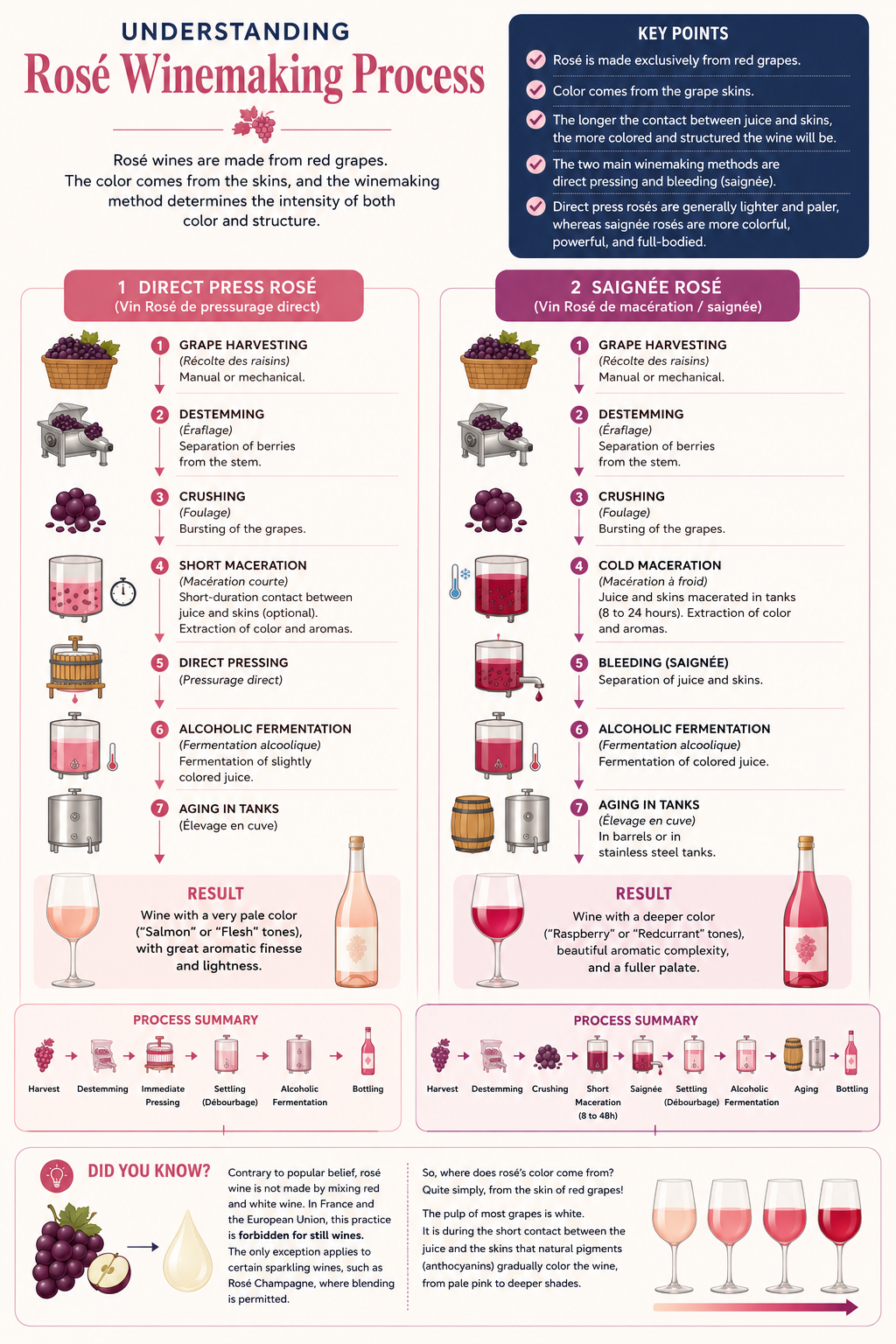
From Vineyard to Bottle: The Main Stages of Rosé Winemaking
Contrary to popular belief, rosé wine is not made by blending red and white wine. It is produced exclusively from black grape varieties, whose pulp is naturally clear. The wine's colour comes solely from the grape skins, which contain the natural pigments known as anthocyanins.
The secret of rosé winemaking lies in the length of skin contact. The juice remains in contact with the skins for only a few minutes to a few hours, compared with several days for red wines. The longer this contact lasts, the deeper the colour and the greater the structure of the wine.
Among the grape varieties most commonly used are Grenache, Cinsault, Syrah, Mourvèdre, Pinot Noir, and Gamay, depending on the region and appellation.
Direct Press Rosé
Widely used in Provence, this method produces pale, fresh and delicate rosé wines.
After harvest, the grapes are generally destemmed and lightly crushed before being pressed immediately. The juice remains in contact with the skins only during pressing, resulting in minimal colour extraction.
The must is then settled (débourbage) to remove suspended solids before being transferred to tanks for alcoholic fermentation, during which yeasts naturally convert sugars into alcohol over approximately ten days.
After fermentation, the wine is aged for several weeks or months to stabilise before bottling.
The result
- Very pale colour
- Excellent freshness
- Citrus, white flower and fresh fruit aromas
- Light, elegant palate
Saignée Rosé (Bleeding Method)
This technique is closer to red winemaking and is commonly used for more structured rosé wines, such as those produced in Tavel.
After destemming and crushing, the grapes macerate with their juice for 8 to 48 hours.
During this short maceration, the pigments and aromatic compounds contained in the skins gradually colour the must.
Once the desired colour has been reached, part of the juice is drawn off from the bottom of the tank—this is known as the saignée ("bleeding") method. The juice then continues its fermentation in the same way as a white wine.
Following alcoholic fermentation, the wine undergoes a relatively short ageing period before bottling.
Depending on the desired style, malolactic fermentation may be carried out to soften the acidity and add roundness, although it is often avoided in order to preserve the fresh, vibrant character of rosé wines.
The result
- Deeper colour
- Greater structure
- Aromas of ripe red berries, spices and sometimes stone fruits
- A rosé well suited to accompany an entire meal
The Main Stages of Rosé Winemaking
- Harvest
- Destemming (optional, depending on the winery)
- Crushing (optional)
- Direct Pressing or Short Skin Maceration (Saignée Method)
- Juice Settling (Débourbage)
- Alcoholic Fermentation
- Ageing
- Bottling
Did You Know?
Contrary to popular belief, blending red and white wine to produce still rosé wine is prohibited throughout the European Union.
The only exception applies to certain sparkling wines, most notably Rosé Champagne, where blending white and red base wines is permitted.
Why is blending prohibited?
For centuries, rosé wines have traditionally been produced through short skin maceration or direct pressing of black grapes.
In 2009, the European Commission considered authorising the blending of red and white wines to produce certain rosés. The proposal met strong opposition from European wine producers, who believed it would undermine the traditional know-how and identity of rosé winemaking.
The proposal was ultimately withdrawn in order to preserve the authenticity and quality of European rosé wines.
Key Takeaways
✔ Rosé wine is made exclusively from black grapes.
✔ Its colour comes from the grape skins.
✔ The longer the juice remains in contact with the skins, the deeper the colour and the greater the structure of the wine.
✔ The two principal winemaking methods are Direct Pressing and the Saignée Method.
✔ Direct press rosés are generally lighter, fresher and paler, whereas saignée rosés are darker, fuller-bodied and better suited to food pairing.
Direct Press Rosé
Harvest → Destemming → Immediate Pressing → Juice Settling → Alcoholic Fermentation → Ageing → Bottling
Saignée Rosé
Harvest → Destemming → Crushing → Short Skin Maceration (8–48 hours) → Saignée (Bleeding) → Juice Settling → Alcoholic Fermentation → Ageing → Bottling