Shopping Cart
There are no more items in your cart
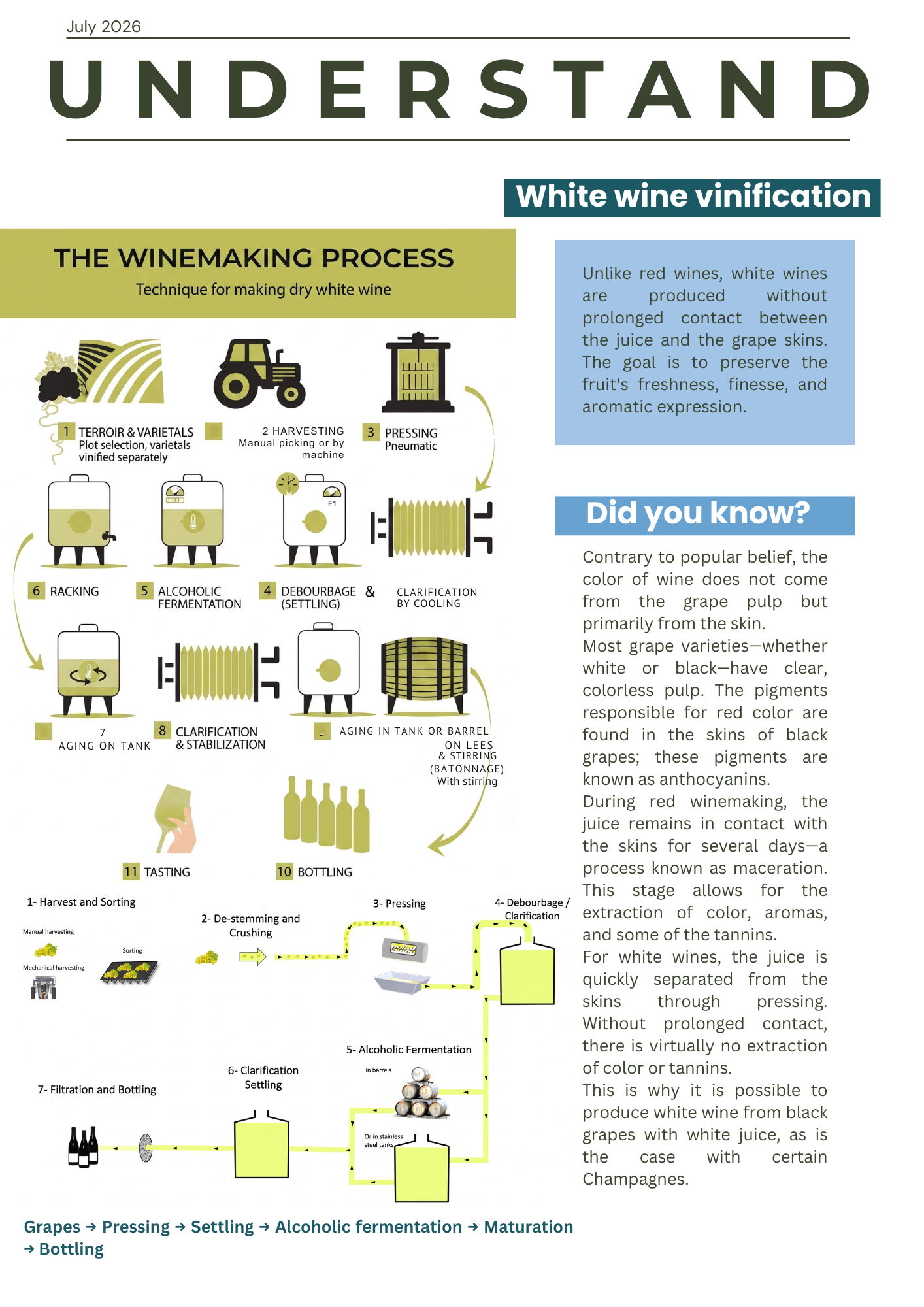
Understanding White Wine Vinification
White wine is produced by pressing the grapes before fermentation, limiting skin contact to preserve freshness and delicate aromas. The winemaker then guides fermentation and ageing to create the desired wine style.
Unlike red wines, white wines are produced without prolonged contact between the juice and the grape skins. The objective is to preserve the fruit's freshness, finesse, and aromatic expression.
White wines can be made from white grape varieties as well as from certain black grape varieties with white flesh. In both cases, the principle remains the same: the juice is separated from the solid parts of the grapes as quickly as possible to avoid extracting colour and tannins.
1. Harvest
The grapes are harvested once they have reached optimal ripeness. They are then quickly transported to the winery to preserve their freshness and aromatic potential.
2. Destemming and Crushing (Optional)
Depending on the desired wine style, the grapes may be destemmed to remove the stems before being gently crushed to break the berries and facilitate juice extraction.
Some winemakers also choose to carry out a short cold skin maceration to extract additional aromatic compounds from the grape skins.
3. Pressing
Pressing is one of the most important steps in white winemaking.
The grapes are gently pressed to extract the juice while limiting the extraction of compounds found in the skins and seeds.
Unlike red winemaking, pressing takes place before fermentation.
4. Juice Settling (Débourbage)
After pressing, the juice is cloudy because it still contains suspended solids such as pulp, skin fragments and other particles.
During settling, these solids naturally sink to the bottom, producing a clearer juice ready for fermentation under optimal conditions.
5. Alcoholic Fermentation
Yeasts convert the natural sugars present in the grape juice into alcohol and carbon dioxide.
To preserve freshness and delicate aromas, fermentation is generally carried out at low temperatures, between 14°C and 20°C (57–68°F).
This is the stage where grape juice truly becomes wine.
6. Malolactic Fermentation (Optional)
Depending on the desired style, the winemaker may decide whether or not to carry out malolactic fermentation.
This natural process converts malic acid, which is sharp and crisp, into lactic acid, which is softer and rounder.
Completed: the wine gains roundness, body and texture.
Blocked: the wine retains greater freshness and vibrant acidity.
Alcoholic fermentation creates the wine. Malolactic fermentation shapes its style.
Malolactic Fermentation: YES or NO?
After alcoholic fermentation, the winemaker can choose whether to encourage or prevent malolactic fermentation.
This natural conversion transforms malic acid (bright acidity, similar to green apple) into lactic acid (softer, creamier acidity).
YES – Malolactic Fermentation Completed
The wine develops more:
- Roundness
- Body
- Richness
- Smoothness
This style is often preferred for:
- Age-worthy white wines
- Barrel-aged white wines
- Rich, complex wines
Example:
A barrel-aged Châteauneuf-du-Pape Blanc, such as La Fontaine, typically displays greater richness, texture and roundness.
NO – Malolactic Fermentation Blocked
The wine retains:
- Freshness
- Tension
- Natural acidity
- Bright aromatic expression
This style is commonly sought for:
- Fresh, fruity white wines
- Wines intended for early drinking
Example:
Many Loire Valley Sauvignon Blancs retain their natural acidity to preserve freshness and vibrant fruit character.
Key Takeaway
🍏 Malic acid = crisp acidity (green apple)
⬇
🦠 Malolactic fermentation
⬇
🥛 Lactic acid = softer acidity (cream, yoghurt)
7. Maturation
The wine continues to evolve for several weeks or months.
It may be matured:
- In stainless steel tanks to preserve fruit purity and freshness;
- In concrete tanks to promote balance and texture;
- In oak casks or barrels to add complexity, richness and structure.
Some wines are aged on their fine lees. During this process, the dead yeast cells remain in contact with the wine, contributing greater body, richness and aromatic complexity.
The lees may also be regularly stirred (bâtonnage) to further enhance texture and mouthfeel.
8. Stabilisation and Clarification
Before bottling, the wine may be racked, filtered or lightly sulphited to ensure stability and preservation.
These operations produce a clear, stable wine ready for release.
9. Bottling
Once maturation is complete, the wine is bottled.
Depending on its style, it may be released shortly after bottling to preserve freshness or continue ageing in the cellar.
Key Takeaway
The fundamental difference between red and white winemaking is simple:
Red wine → Fermentation takes place with the grape skins.
White wine → The grapes are pressed before fermentation, separating the juice from the skins immediately.
Grapes → Pressing → Juice Settling → Alcoholic Fermentation → Maturation → Bottling
Did You Know?
Contrary to popular belief, the colour of wine does not come from the grape pulp but primarily from the grape skins.
Most grape varieties—whether white or black—have clear, colourless juice. The pigments responsible for the red colour are found in the skins of black grapes and are known as anthocyanins.
During red winemaking, the juice remains in contact with the skins for several days in a process called maceration. This allows the extraction of colour, aromas and part of the tannins.
For white wines, the juice is separated from the skins almost immediately after pressing. Without prolonged skin contact, there is virtually no extraction of colour or tannins.
This is why it is possible to produce white wine from black grapes with white flesh, as is the case for few Champagne wines.